The 2026 case-law earthquake over the Single Register of Short-Term Rentals
The judgments of the “Tribunal Supremo” —the Spanish Supreme Court— of May and June 2026 have annulled the essential elements of the “Registro Único de Arrendamientos de corta duración” —the Single Register of Short-Term Rentals— procedure provided for in Royal Decree 1312/2024, deactivating compulsory registration in the property and movable-assets registries as a condition for offering short-term lets. After this “case-law earthquake”, the “Ventanilla Única Digital de Arrendamientos” —the Digital Single Window for Rentals— and the obligations to transmit data for statistical and coordination purposes remain in place, but the civil‑administrative registration core disappears. This paper analyses what is left of the Single Register after the judgments and how it connects with the Catalan model, where strong administrative and community-level regulation of tourist rentals was already in place.
Royal Decree 1312/2024 was enacted in order to give effect in Spain to Regulation (EU) 2024/1028 on the collection and sharing of data relating to short-term accommodation rental services. The European Regulation starts from the finding that the expansive growth of short-term rentals, driven by digital platforms, is withdrawing housing from the residential market and contributing to rising prices, and requires the Member States to establish registration procedures and a digital single window for the transmission of data between platforms and authorities.
The Royal Decree defines the “short-term accommodation rental service” as the letting for a brief period of one or more units, whether or not for tourism purposes, in return for remuneration, applying the rules on seasonal tenancies in art. 3.2 LAU —the “Ley de Arrendamientos Urbanos”, Spain's urban tenancies act— and the sectoral legislation on “viviendas de uso turístico” —tourist-use dwellings— and on consumer protection. The “unit” is conceived as accommodation, furnished in whole or in part, which is the object of the short-term rental service, hotels, hostels and campsites being excluded. It also defines the “host” or landlord, the “guest” or tenant, the “short-term rental online platform” and the “Ventanilla Única Digital de Arrendamientos” —the Digital Single Window for Rentals— as the national digital gateway for the transmission of data and of information on the uses and purposes of the units.
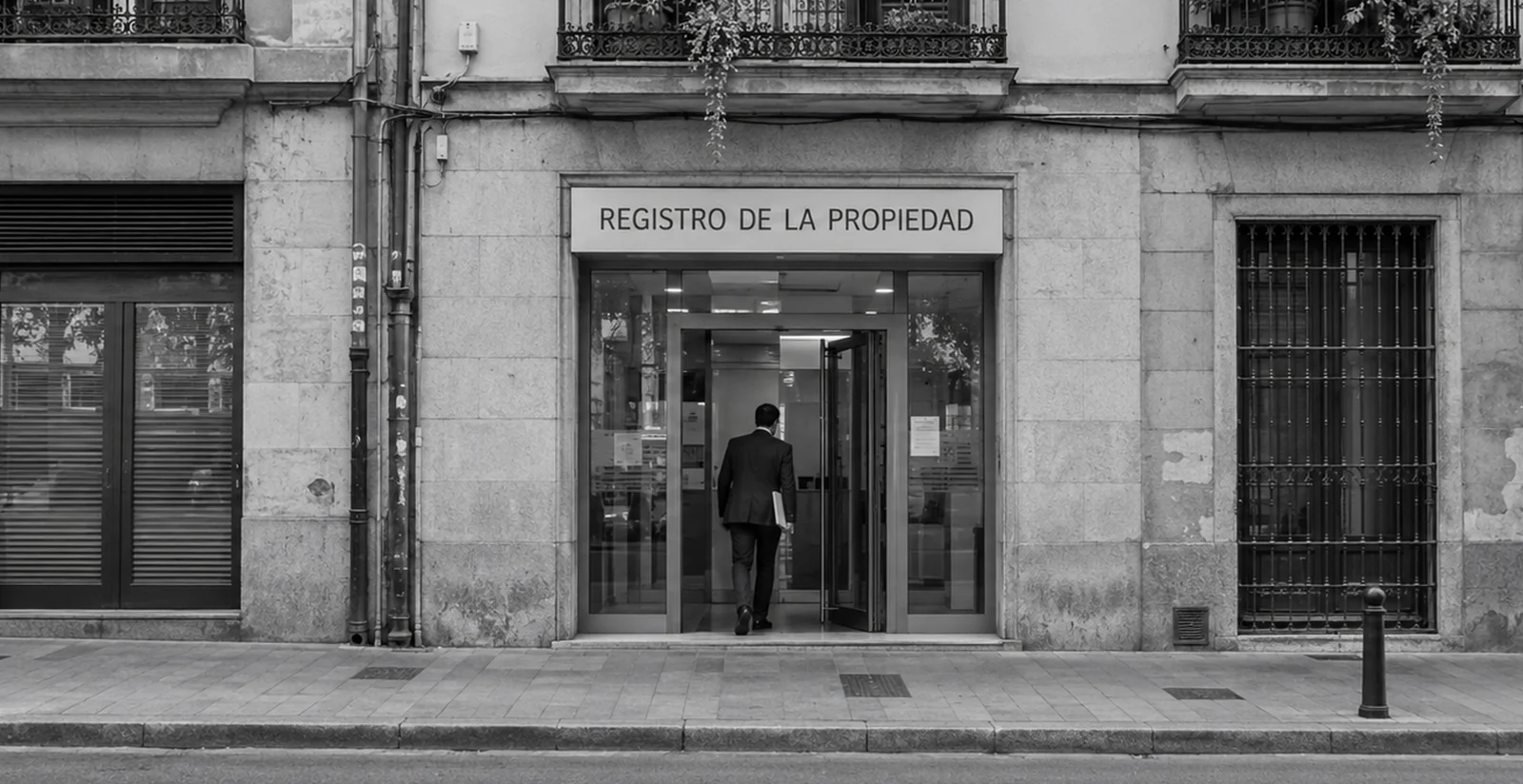
The original design of the Royal Decree brings together two elements. On the one hand, the Single Register of Short-Term Rentals procedure, vested in the “Registro de la Propiedad” —the Land Registry— and in the “Registro de Bienes Muebles” —the Movable Property Registry—, which was to assign a single registration number to each property or partial unit intended to be let separately, without which it could not be offered on short-term rental platforms. On the other, the Digital Single Window for Rentals, vested in the Ministry of Housing and Urban Agenda, responsible for coordinating the transmission of data between platforms and authorities and for providing information on the applicable rules.
The declared purpose of the Single Register was to increase legal certainty and confidence in civil relations inter privatos when entering into short-term tenancy agreements, by guaranteeing that the properties offered met the civil and administrative requirements laid down by law, and by allowing all market operators to have transparent and reliable information. The Royal Decree relied on the State's heads of competence over the organisation of registers and public instruments, the basic rules and coordination of economic planning, the basic conditions of equality and official statistics.
2.The Supreme Court judgments of May‑June 2026
The judgments of the Supreme Court of 19 and 21 May and 4 June 2026, handed down in “recurso contencioso‑administrativo” proceedings —judicial review of administrative action— brought by associations from the tourist apartment sector and by the Generalitat Valenciana —the Valencian regional government—, have annulled much of the Single Register regime. The core of the reasoning turns on the State's lack of competence to regulate an administrative registration procedure for short-term rentals which overlaps with the competences of the “comunidades autónomas” —the Autonomous Communities— in housing and tourism.
The Supreme Court reasons that the register designed by the Royal Decree is eminently administrative in nature, directed at the public control of an economic activity and at obtaining information, and not civil. It cannot therefore be founded on the State's competence over the organisation of registers and public instruments under art. 149.1.8 CE —the “Constitución Española”, the Spanish Constitution—, which refers to registers of a civil or commercial character, such as the Land Registry; competence over administrative registers belongs instead to the underlying subject matter, here housing and tourism, which falls to the Autonomous Communities. It likewise takes the view that the rules exceed the State's competence over the basic rules and coordination of the general planning of economic activity under art. 149.1.13 CE, since they do not confine themselves to laying down basic rules or coordination measures but create a complete, detailed and nationally centralised registration procedure which overlaps with and displaces the registers already existing in the Autonomous Communities, hollowing out their competences. Nor is the head of competence over the basic conditions of equality under art. 149.1.1 CE regarded as sufficient for so exhaustive a body of rules.
As a result, the Court annuls all the provisions of and references in the Royal Decree relating to the Single Register procedure, including, among others, arts. 5 and 8 to 10, as well as the references to the Single Register in other articles and in the additional and final provisions. It does, however, uphold the validity of the provisions on the Digital Single Window for Rentals and on the transmission of data for statistical purposes, taking the view that these do find support in the State's competences over the coordination of economic activity and over official statistics, and are moreover a direct requirement of the European Regulation in order to secure interoperability and the exchange of information.
The “case-law earthquake” therefore consists in the deactivation of the registration core of the Royal Decree, retaining only the layer of coordination and data transmission. The consolidated text of the Royal Decree already incorporates these annulments, so that the Single Register procedure has disappeared from the legal order, while the Single Window and the data obligations remain.
3.What is left of the Single Register after the judgments
After the judgments of May‑June 2026, what remains of the “Single Register” is, in reality, the Digital Single Window for Rentals and the system for collecting and transmitting data relating to short-term accommodation rental services. The Single Window continues to be the national digital gateway for the electronic transmission of data between platforms and the competent authorities, and for providing information on the various uses, rules and purposes of the units devoted to short-term rentals throughout the national territory. Short-term rental online platforms remain under a duty to transmit activity data, such as the number of nights for which a unit is let, the number of guests and their country of residence, in accordance with the European Regulation and with art. 11 of the Royal Decree, which remains in force.
What disappears is the requirement to obtain a single registration number in the Land Registry or in the Movable Property Registry as a condition for offering the unit on platforms, together with the registry's verification of civil and administrative requirements. Control of the lawfulness of short-term rental activity, in terms of tourism licences, planning uses, compliance with municipal by-laws and the tourism and housing legislation of the Autonomous Communities, reverts entirely to those Communities and to the municipalities, which already had their own administrative registers of tourist-use dwellings, notification or authorisation procedures and systems of inspection and penalties.
In practice, the “Single Register” is reduced to a system of information and coordination, with no constitutive or authorising effect on the activity. The Single Window allows regional and local authorities to access aggregated and disaggregated data on short-term rental activity, making it easier to compile statistics, assess the impact on the residential market and design public policies, but it neither replaces nor conditions the registers and procedures of the Autonomous Communities.
4.Connection with the Catalan model for regulating tourist rentals
Catalonia is a paradigmatic case of strong administrative and community-level regulation of tourist rentals. Law 13/2002, on tourism in Catalonia, defines tourist-use dwellings as dwellings made available by their owner, directly or indirectly, to third parties in return for financial consideration, for a seasonal stay, in conditions of immediate availability and with the characteristics laid down by regulation, and requires the corresponding authorising instrument in order to commence the activity, as well as entry in the “Registre de Turisme de Catalunya” —the Catalan Tourism Register—. Decree 75/2020, on tourism in Catalonia, develops those rules: it defines the tourist-use dwelling, sets its maximum capacity, lays down habitability requirements, minimum services, information obligations and rules of neighbourly conduct, and establishes a regime of administrative discipline with inspection and penalties.
The Catalan legislation requires the Tourism Register entry number to appear in all advertising, promotion or marketing of tourist accommodation, and classifies as an infringement the marketing of accommodation without an authorising instrument or without stating the registration number, as well as exceeding the maximum number of users accommodated, failure to report clandestine activity and the omission of measures against conduct that undermines neighbourly coexistence. In addition, Law 5/2020 strengthens the penalty regime and allows Barcelona City Council to lay down particular requirements and time limits for tourist-use dwellings and shared homes, in view of its special regime.
Against that background, the State's attempt to create a Single Register of Short-Term Rentals vested in the Land Registry was superimposed on an already consolidated regional framework, generating risks of duplication, legal uncertainty and the hollowing out of competences. In annulling the Single Register procedure, the Supreme Court judgments implicitly recognise the primacy of the Autonomous Communities' administrative registers in tourism and housing, and the need for the State to confine itself to coordination and statistical functions.
For Catalonia, the practical effect is that the Digital Single Window for Rentals becomes an instrument complementing its own system of registers and control. The Generalitat —the Catalan government— may use the Window to access platform activity data, cross-check it against its Tourism Register and against the rental-deposit register held by INCASÒL, the Catalan land institute, and improve the detection of clandestine or irregular activity. But authorisation of the activity, registration of tourist-use dwellings, the setting of requirements and the imposition of penalties remain matters for the Autonomous Community and the municipalities.
5.Outlook after the “case-law earthquake”
After the judgments of May‑June 2026, the picture of the Single Register of short-term rentals becomes clearer in several respects. First, the competence of the Autonomous Communities in tourism and housing to regulate administrative registers, authorisation or notification procedures and penalty regimes for short-term rentals is reaffirmed. The State may not impose a centralised administrative register vested in the Land Registry which conditions access to the activity, but it may establish a digital Single Window and data transmission obligations in order to secure the application of the European Regulation and coordination between administrations.
Secondly, the view is consolidated that legal certainty in civil relations arising from short-term tenancies is not achieved through a State civil‑administrative register, but through the correct application of the LAU, the Civil Code and the tourism and housing legislation of the Autonomous Communities, together with the transparency and reliability of the information available. The Single Window and the registers of the Autonomous Communities may contribute to that transparency, but they do not replace the function of the civil registers or the parties' freedom of contract.
Thirdly, room opens up for enhanced cooperation between the State and the Autonomous Communities on data and statistics. The European Regulation requires platform activity data to be transmitted to the competent authorities and used to compile statistics on tourism and housing. The Single Window may be the technical channel, but the interpretation and use of that data in order to design housing policies, regulate tourist rentals or declare “zonas tensionadas” —areas of stressed housing market— falls largely to the Autonomous Communities.
In the case of Catalonia, the coexistence of the State Single Window, the Tourism Register, the INCASÒL rental-deposit register and the register of “grandes tenedores” —large-scale housing holders— creates a rich information ecosystem, capable of strengthening the “administrative policing” of housing and tourist rentals. The key will lie in avoiding overlaps, safeguarding the protection of personal data and ensuring that coordination between registers translates into an effective improvement in inspection and enforcement capacity, without generating disproportionate burdens for operators.
In short, after the 2026 “case-law earthquake”, the Single Register of Short-Term Rentals has been emptied of its registration content, but the data and coordination architecture that accompanied it remains standing. What is left is a system of Single Window and data transmission which must be integrated with the models of the Autonomous Communities, such as the Catalan one, in order to address effectively the challenges posed by short-term rentals for the housing market and urban coexistence.