Artificial intelligence and volume legal case management: what can be automated and what a lawyer must continue to decide
Artificial intelligence can substantially improve the handling of large volumes of documents and case files, but its usefulness depends on distinguishing between automating tasks and delegating legal decisions. Classifying information, detecting issues or preparing drafts can bring efficiency; assessing the evidence, taking on risk or defining a strategy continues to require oversight and professional judgement.
Artificial intelligence has a particularly obvious application where legal work involves large volumes of information. Classifying documents, extracting particular data, comparing case files, locating clauses, identifying communications, preparing drafts or detecting possible issues are all tasks in which these tools can significantly reduce the time spent on repetitive work.
In volume legal case management, that capability can produce a considerable improvement. Where a team works with hundreds or thousands of sets of proceedings, even a small reduction in the time needed for certain tasks can translate into a significant difference in terms of efficiency and capacity for control.
But introducing artificial intelligence first requires an answer to a question far more important than the purely technological one: which tasks we wish to automate and which decisions must remain the direct responsibility of a lawyer.
The question is, moreover, of particular topicality in 2026. The European Artificial Intelligence Regulation —the EU AI Act— has been rolling out its regime progressively and, since 2 August 2026, the bulk of its provisions has become applicable, without prejudice to those rules subject to specific timetables. The professional use of these tools must now be approached not only from the point of view of their usefulness, but also from that of governance, oversight and the responsibilities attaching to their use.
1.Automating a task is not automating a decision
That distinction should be the starting point.
A system can analyse hundreds of documents and identify the date of a contract, the amount of an invoice, the number of a policy or particular references within a court decision. That is not the same as deciding whether a cause of action is barred by limitation, whether there is cover, whether a person is liable or whether it is advisable to commence proceedings.
In the first situation we are using technology to locate and organise information. In the second we would be transferring a legal conclusion to a tool.
Confusing the two can create a false sense of efficiency and security.
A lawyer continually uses information in order to take decisions. Artificial intelligence can help to find it, structure it, summarise it or compare it. But the fact that it can take part in those stages does not mean that it should automatically take on the assessment that follows.
The difference is especially important where there are factors that cannot easily be reduced to a rule. A piece of evidence may appear sufficient in documentary terms and yet display weaknesses when analysed in the full context of the litigation. A settlement proposal may be reasonable having regard solely to the amount involved and prove inadvisable if the client has other interests that need to be protected.
Legal strategy combines variables that are not always capable of automation.
2.Where artificial intelligence can add real value
The most useful applications may lie precisely in those tasks that consume time without themselves requiring a final legal decision.
Document classification is a clear example. A portfolio may contain thousands of contracts, invoices, policies, reports, communications and decisions. Identifying and sorting all those documents by hand can consume a significant amount of resources.
A tool capable of carrying out an initial classification allows the lawyer to reach the relevant information sooner.
The same applies to data extraction. If a date, an amount or a reference already appears within a document, it may be inefficient to key it in again by hand in another system. Artificial intelligence can help to locate it and propose that it be carried over.
It can also be used to compare large groups of documents, to detect differences from a template, to locate particular clauses or to flag case files in which expected documentation is missing.
These capabilities are of particular interest in management by exception.
If most case files follow a common pattern, technology can help to locate those that depart from it so that professional attention can be directed towards them.
3.The problem of errors at scale
Generative artificial intelligence has a feature that is particularly relevant to legal work: it can produce a result that is convincing in form and wrong in substance.
A text may be perfectly drafted, use appropriate legal terminology and yet contain a wrong date, attribute to a document something it does not say, or include an incorrect reference.
In an individual case file, that risk calls for review.
In a portfolio of several thousand, it calls for a control system.
An apparently low error rate can affect a considerable number of matters when the tool is used on a large scale.
And the problem may be aggravated if the output generated by one system is then used as the input to another automated process. An incorrect classification may cause the case file to follow a workflow that is not the right one for it. A wrongly extracted item of data may find its way into a document. An erroneous date may produce a mistaken alert.
Automation can generate chains of decisions in which an initial error propagates.
For that reason, the greater the impact of a tool on the later stages of the case file, the higher the level of validation must be.
4.Oversight has to be part of the design
It is not enough to state that every artificial intelligence output will subsequently be reviewed by a lawyer.
It must be determined how that review is to be carried out.
If the tool extracts twenty items of data from each case file and the professional has to check all twenty again by hand, the efficiency obtained may be very limited. If none of them is checked, an unnecessary risk may be taken on.
The solution lies in designing controls matched to the importance of the information.
Certain data can be checked automatically against structured sources. Others can be subjected to sample checks. Inconsistencies can trigger alerts. And those variables with particularly significant legal consequences may require express human validation.
Oversight is not a generic activity added at the end. It forms part of the architecture of the process.
This also requires determining what degree of reliability we need for each task. The initial classification of a document carries a different risk from the calculation of a time limit. Generating an internal summary does not have the same consequences as automatically inserting an assertion into a claim.
Not all applications should be subject to the same level of control.
5.Generating drafts calls for reviewing the content, not the style
The preparation of documents is another obvious use.
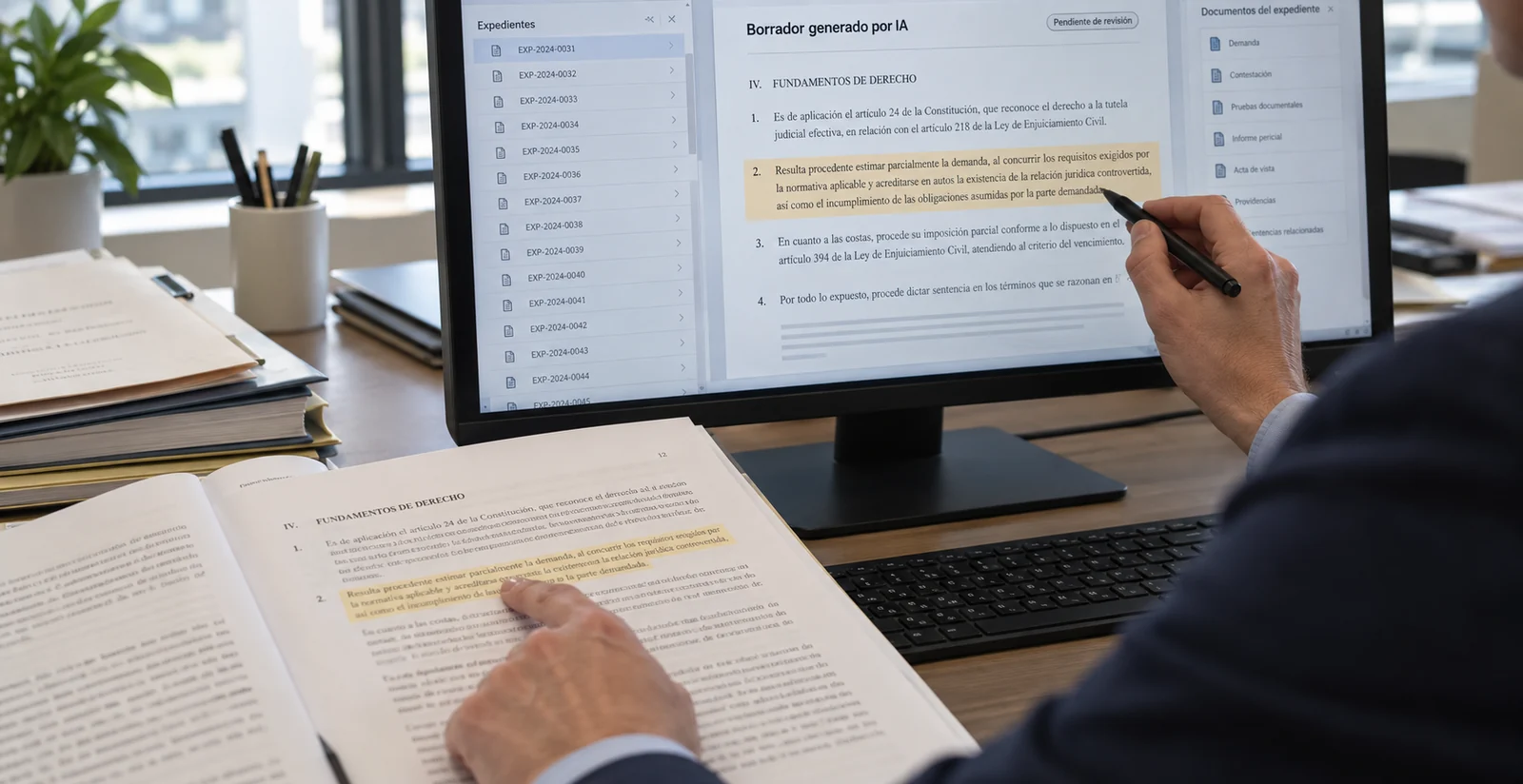
Where a portfolio shares a common legal structure, there is no point in drafting each pleading from scratch. Artificial intelligence can help to adapt templates, to incorporate information from the case file and to produce a first version.
But the ease with which these systems generate professional-looking texts may become precisely one of their greatest risks.
A clearly defective text compels review. A fluent, coherent and technically plausible text may inspire a confidence it does not deserve.
Review must address what the text says and not merely how it says it.
The facts must match the case file. The amounts must be correct. The relief sought must match the legal position. The references used must exist and be pertinent. And any exceptional circumstances must have been identified.
Artificial intelligence can prepare a draft. Responsibility for the document that is ultimately used remains the professional's.
6.Detecting a difference does not mean understanding its importance
One of the most interesting applications consists in comparing case files and locating departures from a pattern.
The system can detect that a clause is worded differently, that a document is missing or that a communication contains unusual terms.
That capability can be extraordinarily useful.
But identifying that something is different and determining what legal significance that difference has are two distinct operations.
A change to a single word may be irrelevant. Another, apparently minor, may completely alter the scope of an obligation. Missing documentation may be secondary in one matter and essential in another.
The tool can draw attention to the difference. The lawyer must decide what it means.
This division of roles is particularly apt in volume case management. Technology can drastically reduce the universe of matters requiring review, allowing legal knowledge to be concentrated precisely on those in which there is a possible issue.
7.Confidentiality, data and responsible use
Legal case files frequently contain restricted information, personal data, corporate documentation and communications subject to confidentiality obligations.
The use of artificial intelligence does not alter those obligations.
Before feeding client information into a tool it is necessary to know how it is processed, where it is stored, who may access it, for how long it is retained and what subsequent use may be made of the data.
In an organisation working with large volumes, this question cannot depend exclusively on the individual decisions of each user.
There must be common criteria as to which tools may be used, with what information and for what purposes.
Technological convenience should not turn the documentation in a case file into information indiscriminately available to any external system.
The training of the people who use these tools is likewise essential. Not all lawyers need a thorough knowledge of how they work technically, but they do need to understand their capabilities and their limitations.
Knowing that a result may be wrong even though it is convincingly drafted is a basic condition for using the technology responsibly.
8.Data can help to improve strategy
Artificial intelligence can also add value in relation to the portfolio as a whole.
It can help to identify which types of objection appear most frequently, which documents are systematically missing, which arguments recur in particular decisions or which groups of case files share common features.
That information can be used to review strategy.
But a correlation does not in itself amount to a legal conclusion.
The fact that a particular category of matters produces a different outcome may be due to a variable that we have not yet identified. The tool can help to detect the phenomenon. The lawyer must investigate its cause and determine its relevance.
Data make it possible to ask better questions, but they do not remove the need to interpret them.
This distinction is important in order to avoid an excessively quantitative view of legal practice. The right decision is not always the one that produces the statistically most frequent outcome. The facts, the evidence, the client's interests and the context of each matter must all be considered.
9.Technology should free up judgement, not replace it
There are decisions that, by their very nature, should not be confused with automatable tasks.
Determining whether it is advisable to bring a claim, to accept a settlement, to discontinue, to amend the relief sought or to take on a particular litigation risk, or assessing whether the available evidence is sufficient, calls for the integration of facts, law, evidence, economics and the client's objectives.
Artificial intelligence can provide information to help in taking these decisions. It can organise documents, summarise background material, compare case files or display possible issues.
But responsibility for the decision continues to lie with the professional.
In civil liability, for example, a system can organise reports and documentation, but making a legal assessment of the relationship between conduct and particular harm may call for an understanding of complex technical and evidential questions.
In insurance, the tool can locate the relevant clauses of a policy, but determining their scope in relation to a specific insured event may require a broader contractual and legal analysis.
The aim should not be to automate as many steps as possible simply because we are technically able to do so.
The right question is which tasks do not genuinely require legal judgement and can be performed more efficiently by means of technology.
If a tool can review thousands of documents and locate within minutes the case files that present a possible issue, its usefulness is obvious. If we expect that same tool to decide, without oversight, on which of them proceedings should be brought or which settlement should be accepted, we are raising a completely different question.
The real transformation does not consist in replacing the lawyer with a system capable of producing documents. It consists in building an organisation in which technology handles information and repetitive tasks better so that the professional can devote more time to what can only be resolved through knowledge, experience and judgement.
In volume legal case management that balance is especially important. Technology makes it possible to work at scale and artificial intelligence considerably broadens the tools available for doing so. But strategy, the assessment of risk and responsibility for decisions must continue to rest with a clearly identified professional.
The relevant question, therefore, is not how much of the law we can automate, but how we can use technology so that legal knowledge is concentrated precisely where it remains indispensable.