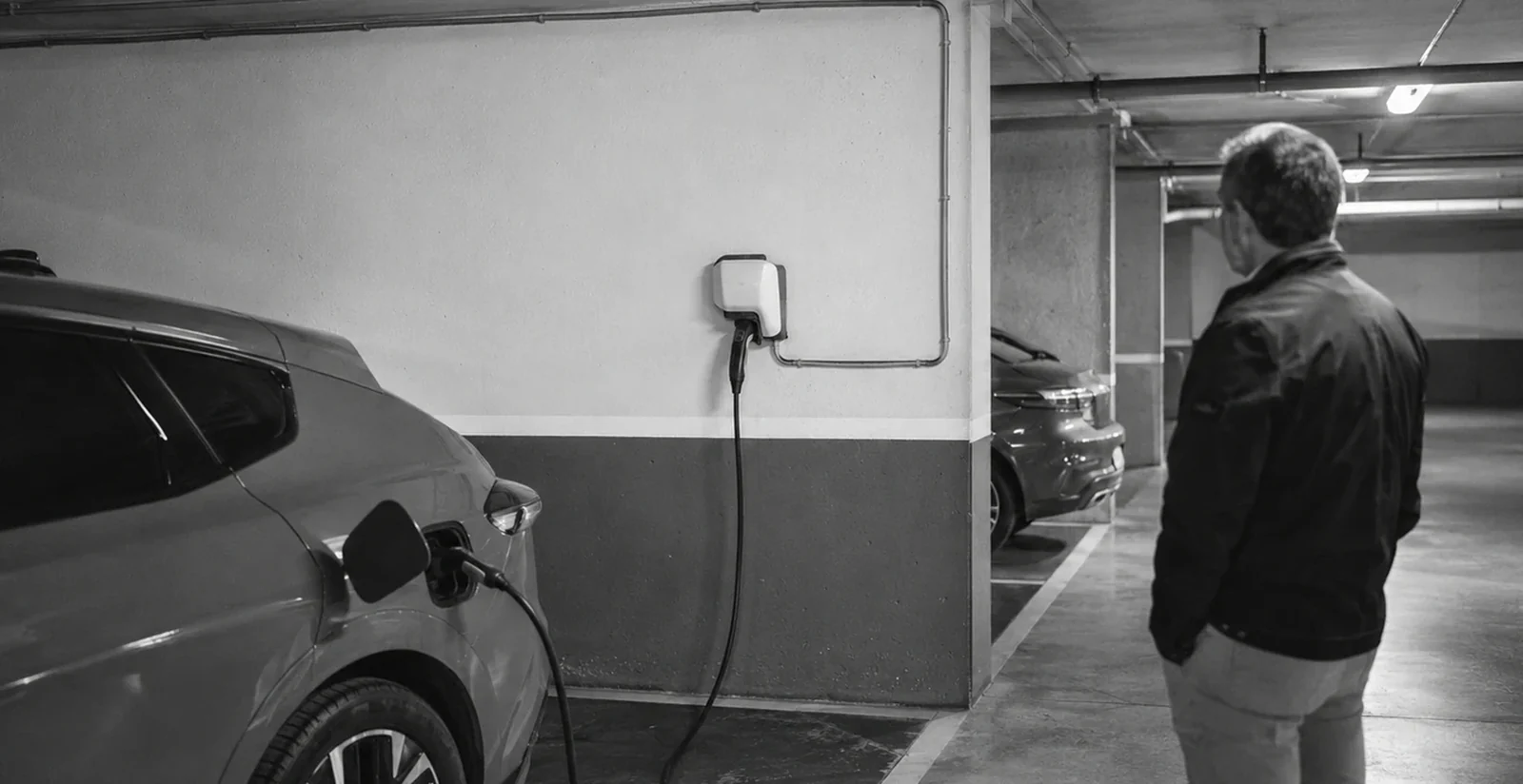
Condominium law and electric mobility: how far an owners' association may go against a private charging point
The expansion of electric mobility has carried into condominium law —“propiedad horizontal”— the conflict between the individual right to install charging points and the protection of the common elements. The “Tribunal Supremo”, Spain's Supreme Court, in a judgment of December 2025, has construed the state “Ley de Propiedad Horizontal” —the LPH, the Spanish national condominium act— as meaning that the installation of a charger in an individual space requires only prior notification to the owners' association, even where the cable crosses common elements, unless there is unnecessary, disproportionate or harmful interference. In Catalonia, where Book Five of the “Código Civil de Cataluña” —the Catalan Civil Code, CCCat— applies, that solution cannot be transposed mechanically. The legal interest lies in comparing the state model with arts. 553 et seq. of the CCCat and in determining the scope of the individual right to install charging infrastructure within the framework of Catalan condominium law.
1.The state solution: prior notification and the limits of interference with the common elements
The state “Ley de Propiedad Horizontal” —the LPH, the Spanish national condominium act—, following the reforms designed to facilitate electric mobility, recognises the right of the owner of a parking space or of a privately owned unit to install a charging point for electric vehicles, subject to prior notification to the owners' association and to bearing the installation and consumption costs. The judgment of the “Tribunal Supremo”, Spain's Supreme Court, of December 2025 consolidates that interpretation, stressing that installation in an individual space requires neither a resolution of the general meeting nor express authorisation, even if it involves the laying of cabling or the placing of items over common areas, provided that the interference is necessary and proportionate to the purpose of charging.
The Court nevertheless introduces qualitative limits. The association may object or require changes where the installation entails unnecessary, disproportionate or harmful interference with the common elements or with other owners. This is a review of reasonableness and proportionality, which prevents the individual right from being exercised abusively or with serious impairment of the structure, the safety or the appearance of the building. The association further retains the power to resolve upon collective solutions, such as the introduction of communal charging systems, which may modulate the exercise of individual rights.
2.The Catalan framework: its own condominium regime and rights of use
In Catalonia, condominium law —“propiedad horizontal”— is governed by the “Código Civil de Cataluña” —the Catalan Civil Code, CCCat—, which lays down its own complete regime. Arts. 553 et seq. CCCat govern the association, the privately owned and common elements, the majorities and the prohibitions on use. Art. 553‑40 provides that owners and occupiers may not carry out, either in the privately owned units or in the rest of the building, activities or acts contrary to normal community life or that damage or endanger the building, and it empowers the association to demand that they cease and, where appropriate, to bring the cessation action (“acción de cesación”). Art. 545‑4 recognises that holders of the right of ownership may establish voluntary limitations on the exercise of their powers, thereby creating limited rights in rem governed by freedom of contract.
That framework means that any installation affecting common elements must comply with the by-law rules, with the resolutions of the general meeting and with the registered voluntary limitations. The association may have laid down, for example, restrictions on installations on façades, ceilings or common areas, or on the laying of visible cabling. The installation of a private charging point that requires common elements to be crossed lies at the intersection between the individual right to use the space and the regime protecting the common elements.
Unlike the state LPH, the CCCat contains, on the information available, no specific provision on charging points, so that the solution must be derived from general principles. The right of each owner to adapt their privately owned unit to their needs, including electric mobility, is recognised to the extent that the by-law prohibitions are not infringed and no damage or danger is caused to the building. The association may restrict uses by means of the by-laws, provided that these are registered at the “Registro de la Propiedad”, the Land Registry, and are enforceable against third parties, and it may react against activities affecting community life or safety.
3.A comparison between the state model and the Catalan model
The state solution, based on prior notification and on a presumption that the individual installation is lawful, subject to the limits of unnecessary, disproportionate or harmful interference, reflects a clear legislative policy of promoting electric mobility. The legislature has sought to remove the barriers raised by owners' associations, shifting the centre of gravity towards the individual right, and the Supreme Court has reinforced that approach.
In Catalonia, the model is more open and depends on the construction of arts. 553 et seq. CCCat. The association has greater latitude to regulate the use of common elements and to establish voluntary limitations, provided that the majorities and registration at the Land Registry are respected. The installation of a private charging point may in practice require a resolution of the general meeting where it involves works on common elements, especially if the by-law rules so provide. The association may assess the interference with the structure, with fire safety, with the appearance of the building and with community life, and it may impose technical or siting conditions.
However, the principle of the social function of property and the need to adapt buildings to new technological requirements suggest that the individual right to install charging infrastructure must also be recognised in Catalonia, subject to reasonable limits. The association cannot prohibit any and every charging installation absolutely and in general terms, without offering alternatives, without incurring a possible abuse of rights or a disproportionate limitation of the use of the privately owned units. The comparison with the state solution offers a guiding criterion: the association may control the interference with common elements, but it may not simply block the exercise of a right functionally linked to the normal use of the parking space.
4.The scope of the individual right to install charging infrastructure in Catalonia
Under the Catalan regime, the scope of the individual right to install charging infrastructure may be delimited on several levels. First, the owner of a parking space or of a privately owned unit is entitled to carry out works on their unit in order to adapt it to electric mobility, provided that this does not alter the structure of the building or substantially affect common elements. The installation of the charger in the owner's own space, with cabling running through privately owned areas or through existing ducting, falls within this sphere.
Secondly, where the installation requires common elements such as walls, ceilings or passageways to be crossed, the owner must comply with the by-law rules and with the resolutions of the association. The general meeting may require that the works meet technical criteria, that common ducting be used, that the visual impact be minimised and that safety be ensured. The association may refuse installations entailing unnecessary, disproportionate or dangerous interference, but it should offer reasonable alternatives, such as the creation of communal charging infrastructure.
Thirdly, registered voluntary limitations, such as by-law clauses prohibiting certain installations on common elements, are enforceable against the owners and against third-party acquirers. The association may have resolved, for example, that any installation of charging infrastructure is to be carried out through a communal system managed by the association, which makes the exercise of individual rights conditional. In such cases, the owner will have to channel their charging demand through the communal system, and the association will have to manage its introduction diligently.
Fourthly, the cessation action under art. 553‑40 CCCat gives the association a means of reacting against installations that damage or endanger the building or that give rise to conflicts of community life. If a charging point is installed defectively, without complying with safety rules, or creates a fire risk, the association may demand that it cease and, where appropriate, apply to the courts to obtain the removal or the adaptation of the installation.
5.Conclusions
Electric mobility confronts condominium law with the challenge of reconciling the individual right to install charging points with the protection of the common elements and of community life. The state solution, consolidated by the Supreme Court in December 2025, leans clearly in favour of the individual right, requiring only prior notification and allowing cabling to be laid across common elements, save where there is unnecessary, disproportionate or harmful interference. In Catalonia, the separate regime of the Civil Code calls for a more nuanced construction, in which the by-law rules, the majorities and registration at the Land Registry play a central role.
The legal interest lies in determining how far an owners' association may go against a private charging point. The association may regulate, make conditional and, in extreme cases, prevent installations that seriously affect common elements or safety, but it may not absolutely block the adaptation of the privately owned units to electric mobility without offering reasonable alternatives. The balance between the individual right and the autonomy of the association will be built, in Catalonia, on the basis of arts. 553 et seq. CCCat, of the social function of property and of the comparison with the state solution, in a field where judicial practice and regulatory developments will play a decisive role in the coming years.