We advise on the planning and administration of successions and on the resolution of the disputes that may arise between heirs, forced heirs (“legitimarios”), legatees and others with rights over an estate.
Planning a succession is not merely a matter of making a will. It calls for knowing what the estate comprises, determining which rights have to be respected, arranging the dispositions and anticipating their civil, financial and tax consequences. The question is of particular importance in Catalonia, which has its own law of succession and its own solutions on wills, succession agreements, the forced share (“legítima”), disinheritance, fideicommissary substitutions (“fideicomisos”), intestate succession and the division of the estate.
Our long-standing specialisation in property and contract law allows us to approach a succession beyond the inheritance itself. Behind an estate there are properties, rights in rem, quotas in companies (“participaciones”), family businesses and investments whose transmission calls for an understanding of the estate as a whole. Where the disagreement cannot be settled by negotiation, that specialisation is combined with our experience in civil litigation before the courts of Barcelona, of Catalonia and of the rest of Spain.
Estate planning, wills, succession agreements and fideicommissary substitutions
Proper estate planning makes it possible to decide in advance how the estate is to pass, to avoid uncertainty and to reduce the risk of future disputes between those called to succeed. We advise on the preparation and drafting of notarial and holograph wills, codicils and testamentary memoranda, after analysing with the client the structure of his or her estate, the family circumstances and the objectives pursued.
This advice covers the institution of heirs, legacies and prelegacies, substitutions, particular attributions, the appointment of executors and estate administrators, provisions on the administration of particular assets and, in general, any disposition that allows the succession to be ordered in accordance with the wishes of the deceased.
Planning becomes particularly important where the estate includes a family business, quotas in companies, properties or other assets whose division could jeopardise their continuity or their value. In such cases it is not enough to decide who succeeds; it is also necessary to determine how the transmission may take place and how the interests of the various members of the family are to be coordinated.
In this field Catalan civil law offers instruments of considerable importance, among them succession agreements, which make it possible to agree during one's lifetime on dispositions taking effect on death, such as the institution of heirs or particular attributions. Their binding nature sets them substantially apart from a will and requires their effects to be weighed with particular care before they are formalised.
We also advise on the creation, interpretation and implementation of fideicommissary substitutions. This institution, long established in Catalan succession law, makes it possible to order successive transmissions of particular assets and to lay down a specific legal regime between the fiduciary and the fideicommissaries. The “Código Civil de Cataluña”, the Catalan Civil Code, also provides mechanisms to protect the position of the latter against acts that may jeopardise the assets subject to the fideicommissum.
In all estate planning we address the tax consequences from the outset. The most appropriate solution as a matter of civil law must also be analysed from a tax perspective, so that a well-conceived succession structure does not produce unforeseen tax effects.
Opening of the succession, testate and intestate estates
After the death there begins a stage in which it is necessary to determine who is entitled to succeed, on what title and to what extent. Our work covers obtaining and analysing the death certificate, the certificate of last wills and the certificate of life-insurance policies, locating and examining the will or other instruments of succession, and identifying heirs, forced heirs, legatees and others who may have rights over the estate. Where there is a will, we analyse its dispositions as a whole in order to establish their scope, the position of each interested party and the way in which the will is to be carried out.
Where a person dies without a testamentary heir and the intestate succession opens, we advise on determining the persons called to succeed and on the notarial declaration of heirs ab intestato. Catalan law lays down its own statutory order of succession and recognises a specific position for the surviving spouse and for the surviving partner in a stable partnership (“pareja estable”), to whose rights we pay particular attention. On intestacy, their position varies according to whether or not they concur with descendants and may include, among other rights, a universal usufruct over the estate and certain powers of commutation.
We also act where one of those called to an estate puts off indefinitely the decision whether to accept or repudiate it and that uncertainty brings the succession to a standstill. Catalan law allows certain interested parties to apply to a notary to call upon the person entitled to succeed to state his or her decision within the statutory period.
Acceptance, inventory, legacies and division of the estate
Accepting an estate is a decision with consequences for one's own assets, and one that should be taken after knowing both the assets that make it up and its debts, charges and obligations. We analyse with the heir what the estate consists of and the different ways of accepting it, paying particular attention to cases in which the existence or the extent of the debts makes it advisable to protect the heir's personal assets. Catalan law lays down a specific regime for acceptance under benefit of inventory. If the inventory is drawn up correctly and the statutory requirements are met, the heir's liability for the obligations of the deceased is limited to the assets of the estate and does not extend to his or her own assets.
We advise on drawing up the inventory of the estate, on identifying and valuing assets and liabilities and on analysing the dispositions made by the deceased during his or her lifetime, as well as their possible bearing on the succession. Once the estate has been identified and the persons with rights over it determined, we turn to the division. The composition of the lots calls for attention not only to the economic value of the assets, but also to their nature, their divisibility, the charges on them, the possibilities of allotment and their relationship with the rights of each co-heir.
We advise and assist in negotiations between heirs and in the preparation and execution of the public deeds of acceptance, allotment and division of the estate, as well as in the subsequent registration and tax steps. Our work also covers the performance and delivery of legacies and prelegacies and the resolution of the questions that may arise between heirs and legatees.
The division is often the point at which the disagreements that had lain dormant since the opening of the succession come to the surface. A different valuation of a property, the treatment of a gift made during the deceased's lifetime, the attribution of particular assets or the interpretation of the will can turn what began as an agreed operation into a particularly complex dispute.
Forced share, disinheritance and succession disputes
The forced share is one of the matters that give rise to the most succession disputes. In Catalan civil law the forced share is not framed as a share in the ownership of particular assets of the estate, but as the right of certain persons to obtain a monetary value out of the succession. This framing allows greater flexibility in payment, but it requires a correct determination of its amount, of the attributions to be set against it and of the dispositions made by the deceased that may affect its calculation. We advise both forced heirs seeking recognition and payment of their forced share and heirs facing claims for a forced share or for a supplement to it.
Disinheritance likewise calls for particularly rigorous analysis. In Catalonia it may be based only on the grounds laid down by law and must meet the formal requirements established. One of those grounds is the manifest and continued absence of family contact for a reason attributable exclusively to the forced heir. Where the disinheritance is challenged, proving the ground can become the central question.
Succession disputes may, however, have very different origins. We act in actions for the nullity and ineffectiveness of wills and other dispositions of succession, claims for a forced share and for a supplement to it, the delivery of legacies, disputes over the acceptance or repudiation of an estate, the interpretation of testamentary dispositions, the rights of fideicommissaries and actions for the division or judicial partition of an estate. In these matters we first seek to establish whether there is a negotiated solution that preserves the value of the estate and prevents the dispute from prolonging a state of undivided co-ownership for years. Negotiation is particularly useful where the problem lies not in the existence of the right, but in the valuation of the assets or in the specific way in which they are to be allotted.
Where agreement is not possible, we take charge of the court proceedings. Succession litigation calls for a command of the law governing inheritance and, at the same time, for a properly defined litigation strategy as regards evidence, the valuation of assets, standing and the effects of the relief sought. It is here that the combination of our specialisation in property and contract law and our litigation experience comes fully into its own, because a succession dispute is, in large measure, a dispute about property.
Succession taxation
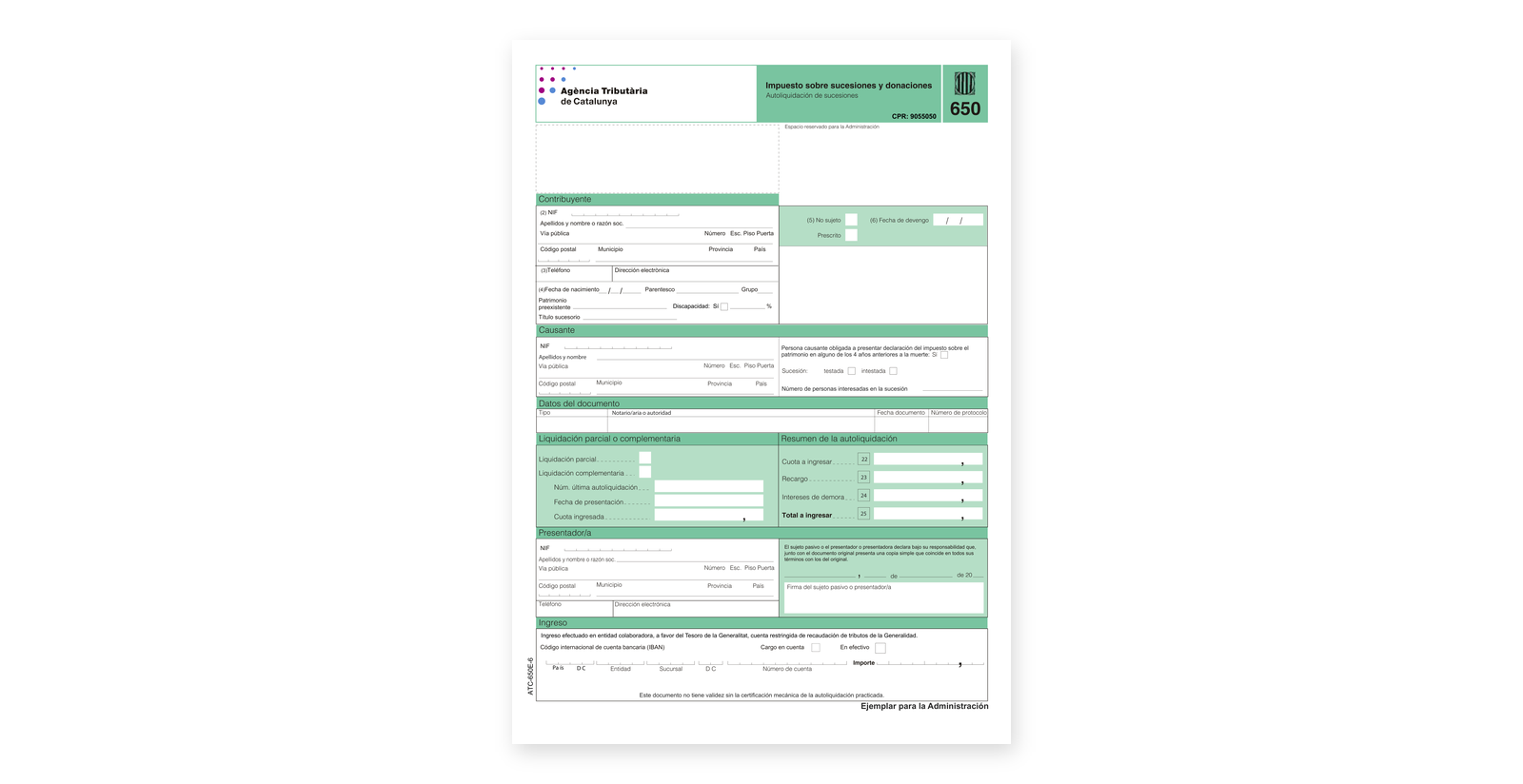
Tax is inseparable from any succession decision. The acceptance of an estate, the way in which the division is carried out, the allotment of certain assets, gifts made during the deceased's lifetime, usufructs or some later transactions may each have different tax consequences. We therefore build the tax analysis in from the outset of the succession, and not only at the point of filing the self-assessment return for the “Impuesto sobre Sucesiones y Donaciones”, Spain's inheritance and gift tax. An operation that is possible as a matter of civil law may not be tax-neutral. Moreover, certain agreements between heirs that depart from the dispositions of the deceased may give rise to tax consequences of their own.