E-scooters, electric bicycles and compulsory insurance: the new map of civil liability in personal mobility in 2026
Law 5/2025 has thoroughly reformed the regime of compulsory civil liability insurance for the use of motor vehicles and has also created a specific compulsory insurance for light personal vehicles, with effect from 2 January 2026. The reform widens the statutory concept of a motor vehicle, incorporates the changes flowing from Directive (EU) 2021/2118 and strengthens the system for the protection of injured parties, redefining the role of the “Consorcio de Compensación de Seguros”, Spain's insurance compensation fund. This new framework has a direct impact on e-scooters, electric bicycles and other forms of micromobility, and raises practical questions as to which vehicles must be insured, the liability of the owner and of the driver, accidents involving pedestrians and the overlap with home or family civil liability policies.
1.A new concept of motor vehicle and the wider scope of compulsory insurance
The reform of the consolidated text of the “Ley sobre responsabilidad civil y seguro en la circulación de vehículos a motor” —the Act on civil liability and insurance in the use of motor vehicles— introduces a new statutory concept of a motor vehicle which departs from the traditional reference to the administrative authorisation to be used on the road. A motor vehicle is any automobile vehicle driven exclusively by mechanical force which travels on the ground and does not run on rails, provided that its maximum design speed exceeds 25 kilometres per hour, or that its maximum net weight exceeds 25 kilograms and its maximum design speed exceeds 14 kilometres per hour. Trailers and semi-trailers intended for use with such vehicles are also included, whether coupled or uncoupled. Railways, trams and other vehicles running on their own tracks are excluded, as are wheelchairs and other specific motorised vehicles for the mobility support of persons with reduced mobility intended exclusively for such persons, although it is made clear that vehicles which meet the definition and have been adapted for use by persons with reduced mobility are indeed regarded as motor vehicles.
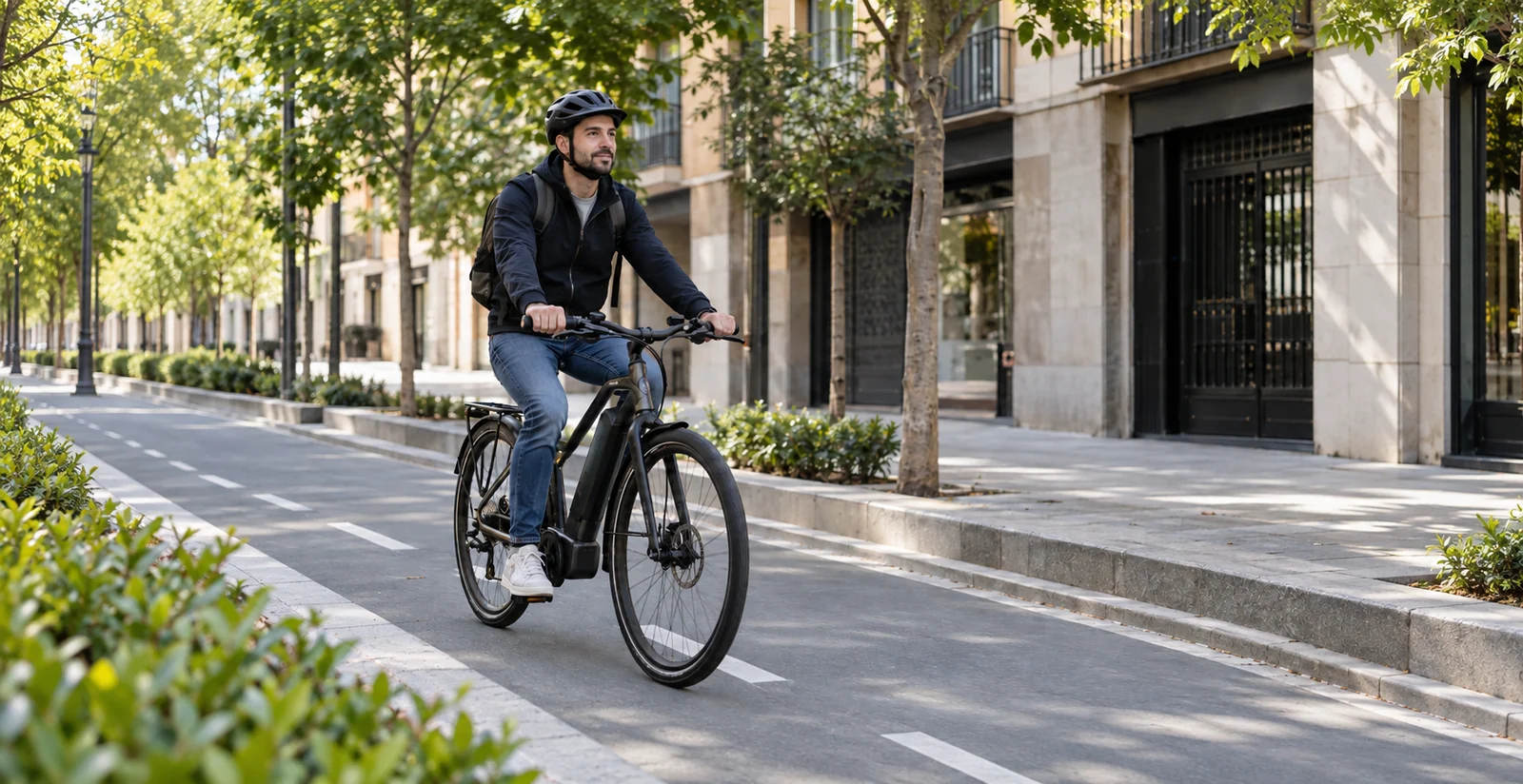
This new concept has direct consequences for the insurance obligation. The owner of any motor vehicle normally based in Spain must take out and keep in force a contract of insurance covering, up to the limits of compulsory cover, the civil liability arising from traffic events. The reform expressly brings within that obligation certain motorised cycles designed to be pedalled with auxiliary propulsion and a maximum speed exceeding 25 kilometres per hour, vehicles falling within category L1e‑B of the European Regulation on the type-approval of two- or three-wheel vehicles and quadricycles, and other pedal vehicles with auxiliary propulsion exceeding 45 kilometres per hour. A proportion of electric bicycles and of motorised cycles whose performance brings them close to mopeds thus become subject to compulsory motor insurance.
The traffic event is also redefined broadly. A traffic event means any use of a motor vehicle consistent with its function as a means of transport at the time of the accident, irrespective of the characteristics of the vehicle, of the terrain on which it is used and of whether it is stationary or moving. This conception reflects the case law of the Court of Justice of the European Union and seeks to avoid exclusions based on the type of road or on uses that are not strictly road uses, thereby strengthening the protection of victims.
2.The creation of compulsory civil liability insurance for light personal vehicles
The major innovation as regards micromobility is the creation of a specific compulsory insurance for light personal vehicles. Law 5/2025 provides that this insurance must be held by light personal vehicles which may be used on the road because they hold a certificate of circulation, are entered in the register of vehicles of the “Dirección General de Tráfico” —the traffic authority— and bear an identification label showing the registration number allocated to them or, where applicable, a number plate. The owner of each light personal vehicle which meets those requirements is obliged to take out and keep in force a contract of insurance covering civil liability up to the minimum sums laid down.
For the purposes of this insurance, light personal vehicles are those which travel on the ground by means of one or more wheels, have a single seating position and are propelled exclusively by electric motors capable of providing a maximum design speed of between 6 and 25 kilometres per hour if their weight is below 25 kilograms, or of between 6 and 14 kilometres per hour if their weight exceeds 25 kilograms. They may be fitted with a seat or saddle only if they have a self-balancing system. Excluded from this category are vehicles designed and manufactured for exclusive use by the Spanish armed forces, motorised vehicles or mobility support devices intended exclusively for persons with disabilities or reduced mobility, and pedal cycles with pedal assistance fitted with an auxiliary motor of a maximum continuous rated power of 250 watts or less whose power decreases progressively and is cut off before the speed reaches 25 kilometres per hour or if the cyclist stops pedalling.
Light personal vehicles used within Spanish territory are subject, with the necessary adaptations, to the civil liability and insurance regime of the consolidated text of the Act on civil liability and insurance in the use of motor vehicles and of its implementing regulation, but with significant particularities. The financial penalties for failure to insure are set at one third of those laid down for motor vehicles. The territorial scope of compulsory insurance for light personal vehicles is confined to Spain, so that the regime of free movement of insured vehicles laid down for compulsory motor insurance in the title devoted to insurance control within the European Economic Area does not apply.
The minimum sums of cover under the compulsory insurance for light personal vehicles are set at 6,450,000 euros per insured event for personal injury, whatever the number of victims, and 1,300,000 euros per insured event for damage to property. Provision is made for those amounts to be updated in order to bring them into line with inflation or with the new minimum figures laid down by European legislation. The direct settlement agreements for material damage concluded between insurers do not apply, and the insurer's right of recourse is expressly recognised, including the possibility of recourse against users who have tampered with the technical characteristics of the vehicle where that tampering has contributed to the insured event or to its aggravation.
3.The liability of the owner and of the driver in the new personal mobility
The basic structure of civil liability arising from the use of vehicles is maintained. The driver of a motor vehicle is liable, by virtue of the risk created by traffic events, for the harm caused to persons or to property. In the case of personal injury, he or she is released from liability only on proof that the harm was due to the exclusive fault of the injured party or to force majeure extraneous to the driving or to the operation of the vehicle, defects in the vehicle and the breakage or failure of its parts or mechanisms not being regarded as force majeure. As regards material damage, the driver is liable to third parties where he or she is civilly liable under the “Código Civil” and the “Código Penal” —the Spanish Civil Code and the Criminal Code— and under the Act itself.
The owner who is not the driver is liable for the harm caused by the driver where he or she is linked to the driver by one of the relationships of liability for the acts of another laid down in the Civil Code or in the Criminal Code, that liability ceasing on proof that he or she exercised all the diligence of the Civil Code's “buen padre de familia”, the reasonable person standard, in order to prevent the harm. In addition, the owner who is not the driver of a vehicle without compulsory insurance is civilly liable together with the driver for the harm caused, unless he or she proves that the vehicle had been stolen from him or her. These rules apply to light personal vehicles in so far as the additional provision which creates their compulsory insurance subjects them to the civil liability regime of the Act, with the adaptations laid down.
In practice, this means that the owner of an electric scooter or of another light personal vehicle which must be insured is liable if he or she has not taken out the compulsory insurance and the vehicle causes harm, and that the driver is liable for the risk created, subject to adjustment for the exclusive or contributory fault of the victim. Tampering with the vehicle, for example in order to increase its maximum speed or its power, may aggravate liability and justify recourse by the insurer against the user who has altered its technical characteristics. The dividing line between a motor vehicle and a light personal vehicle is essential in determining the applicable regime, both in terms of the insurance obligation and in terms of territorial scope and the intervention of guarantee funds.
4.The role of the Consorcio de Compensación de Seguros in personal mobility accidents
The reform strengthens and clarifies the functions of the Consorcio de Compensación de Seguros as a guarantee fund in the field of compulsory motor insurance and extends its intervention to the new insurance for light personal vehicles. The Consorcio compensates personal injury where the vehicle which caused it is unidentified, personal injury and material damage in cases of uninsured vehicles, deregistered vehicles which are being used on the road, vehicles used in restricted areas of ports and airports without equivalent insurance, vehicles used in motoring events without specific insurance, insured vehicles which have been stolen or used deliberately to cause harm, as well as harm in cases of insolvency of insurers and certain cases of importation of vehicles from other Member States.
As regards light personal vehicles, the additional provision which creates their compulsory insurance states that the Consorcio's intervention is confined to personal injury requiring medical attention in the case of injuries or arising from the death of the victim, where the harm is caused by light personal vehicles. The reimbursement functions laid down for compulsory motor insurance are not automatically extended. Provision is made, however, for the Government to extend those functions by regulation to cover material damage and harm caused by the use of light personal vehicles which do not meet the statutory requirements for being on the road, without prejudice to the Consorcio's right of recovery against those liable.
In order to finance those functions as a guarantee fund, the Consorcio receives surcharges on the premiums of the compulsory insurance for light personal vehicles, approved by decision of the “Dirección General de Seguros y Fondos de Pensiones”, the insurance and pension funds supervisor. In addition, provision is made for the Consorcio to take on the underwriting of the risks of light personal vehicles which, although capable of being insured, are not accepted by insurers, on the terms to be laid down by regulation. This offers a route to insurance for vehicles which, by reason of their characteristics or of the profile of their users, encounter difficulties in the market.
5.Accidents involving pedestrians, overlapping insurance and the protection of injured parties
In the new context of personal mobility, accidents between e-scooters, electric bicycles and pedestrians take on particular importance. The civil liability of the driver of a light personal vehicle towards a pedestrian is governed by the general rules of the Act, with the particularity that the traffic event is defined broadly and that the compulsory insurance must cover the personal injury and material damage caused to third parties within the limits of cover. The injured party has a direct right of action against the vehicle's insurer, without having to sue the driver, and the insurer is obliged to make a reasoned offer of compensation within three months of the claim, calculating personal injury in accordance with the valuation system of the Act and itemising the documents and reports on which it is based.
The procedure of reasoned offer and reasoned reply, with the possible involvement of the “Institutos de Medicina Legal y Ciencias Forenses” —the institutes of forensic medicine— in issuing supplementary expert reports, strengthens the protection of victims and seeks to encourage the out-of-court settlement of disputes. Failure to make a reasoned offer within the time limit may give rise to late-payment interest and to administrative penalties for the insurer. If the injured party does not agree, he or she may have recourse to appropriate non-judicial means of dispute resolution or to the courts, and must attach to the claim the reasoned offer or reasoned reply or, failing that, the prior demand made to the insurer.
The overlap with home or family civil liability policies is a practical point of some importance. Many users of e-scooters or of electric bicycles hold home policies which include family civil liability cover, which may cover harm caused as pedestrians or as cyclists not subject to compulsory insurance. However, where the vehicle falls within the scope of compulsory insurance, the primary cover must be that of the vehicle's own policy, and home policies usually exclude harm arising from the use of motor vehicles or of vehicles subject to compulsory insurance. The delimitation of cover and the coordination between policies are governed by the “Ley de Contrato de Seguro”, Spain's Insurance Contract Act, and in particular by the rules on overlapping insurance and on the insurer's subrogation, so that the insurer which pays the compensation may be subrogated to the rights of the insured against the third parties liable, up to the limit of what it has paid.
Where an accident involves an insured light personal vehicle and a pedestrian, the injured party may bring his or her action directly against the vehicle's insurer, and the insurer may not raise against the injured party exclusions other than those laid down by law. If the vehicle is uninsured, the Consorcio may step in as a guarantee fund on the terms laid down for light personal vehicles, at least for personal injury requiring medical attention or arising from death. Correctly identifying the type of vehicle, its insurance regime and any overlapping policies will be essential in determining the cover actually available and the route for bringing a claim.
6.Conclusion: a new map of civil liability for personal mobility
The reform brought about by Law 5/2025 and the entry into force of the compulsory insurance for light personal vehicles from 2 January 2026 shape a new map of civil liability for personal mobility. The concept of a motor vehicle is widened, bringing certain motorised cycles and high-performance electric bicycles within the classic regime of compulsory motor insurance, while a specific regime is created for e-scooters and other light personal vehicles, with requirements of certification, registration and identification and with significant minimum cover.
The owner and the driver of these vehicles take on clear responsibilities, both for the risk created and by reason of the insurance obligation, and the Consorcio de Compensación de Seguros strengthens its role as a guarantee fund, extending its intervention to personal injury caused by light personal vehicles which are uninsured, unidentified, stolen or linked to insolvent insurers. Accidents involving pedestrians and the overlap with home or family civil liability policies are placed in a new context, in which the injured party's direct right of action and the procedure of a reasoned offer of compensation come to the fore.
For legal practice, this new framework requires precise identification of which vehicles must be insured, a distinction to be drawn between a motor vehicle and a light personal vehicle, an analysis of the liability of the owner and of the driver, an assessment of the Consorcio's intervention and the management of the coordination between different insurance policies. Personal mobility ceases to be a marginal area and becomes fully integrated into the system of civil liability and compulsory insurance, with direct implications for e-scooters, electric bicycles and other forms of micromobility which are already part of the everyday urban landscape.